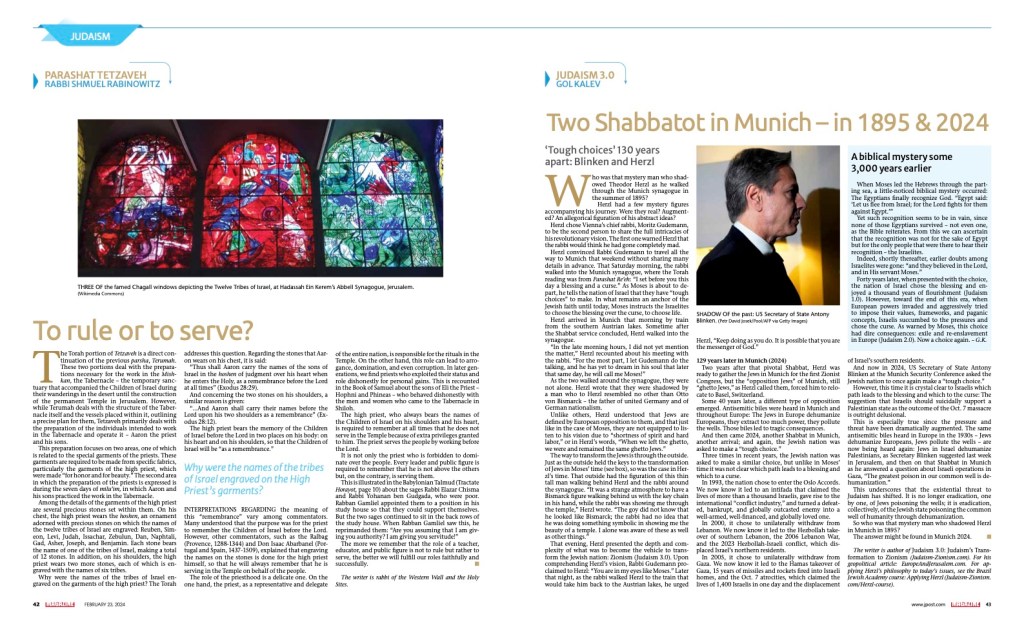
“Tough choices” 130 years apart: Blinken and Herzl
Reprints rom the Jerusalem Post , By Gol Kalev, february 23, 2024
Who was that mystery man who shadowed Theodor Herzl as he walked through the Munich synagogue in the summer of 1895?
Herzl had a few mystery figures accompanying his journey. Were they real? Augmented? An allegorical figuration of his abstract ideas?
Herzl chose Vienna’s chief rabbi, Moritz Güdemann, to be the second person to share the full intricacies of his revolutionary vision. The first one warned Herzl that the rabbi would think he had gone completely mad.
Herzl convinced Rabbi Güdemann to travel all the way to Munich that weekend without sharing many details in advance. That Saturday morning, the rabbi walked into the Munich synagogue, where the Torah reading was from Parashat Re’eh: “I set before you this day a blessing and a curse.” As Moses is about to depart, he tells the nation of Israel that they have “tough choices” to make. In what remains an anchor of the Jewish faith until today, Moses instructs the Israelis to choose the blessing over the curse, to choose life.
Herzl arrived in Munich that morning by train from the southern Austrian lakes. Sometime after the Shabbat service concluded, Herzl walked into the synagogue.
“In the late morning hours, I did not yet mention the matter,” Herzl recounted his meeting with the rabbi. “For the most part, I let Güdemann do the talking, and he has yet to dream in his soul that later that same day, he will call me Moses!”
As the two walked around the synagogue, they were not alone. Herzl writes that they were shadowed by a man who to Herzl resembled no other than Otto von Bismarck – the father of united Germany and of German nationalism.
Unlike others, Herzl understood that Jews are defined by European opposition to them, and that just like in the case of Moses, they are not equipped to listen to his vision due to “shortness of spirit and hard labor,” or in Herzl’s words, “when we left the ghetto we were and remained the same ghetto Jews.”
The way to transform the Jews is through the outside. Just as the outside held the keys to the transformation of Jews in Moses’ time (see box), so was the case in Herzl’s time. That outside had the figuration of this thin tall man walking behind Herzl and the rabbi around the synagogue. “It was a strange atmosphere to have a Bismarck figure walking behind us with the key chain in his hand, while the rabbi was showing me through the temple,” Herzl wrote. “The goy did not know that he looked like Bismarck; the rabbi had no idea that he was doing something symbolic in showing me the beauty of a temple. I alone was aware of these as well as other things.”
That evening Herzl presented the depth and complexity of what was to become the vehicle to transform the Jewish nation: Zionism (Judaism 3.0). Upon comprehending Herzl’s vision, Rabbi Güdemann proclaimed to Herzl: “You are in my eyes like Moses.” Later that night, as the rabbi walked Herzl to the train that would take him back to the Austrian lakes, he urged Herzl, “Keep doing as you do. It is possible that you are the messenger of God”!
129 years later in Munich (2024)
Two years after that pivotal Shabbat, Herzl was ready to gather the Jews in Munich for the first Zionist Congress, but the “opposition Jews” of Munich, still “ghetto Jews,” as Herzl called them, forced him to relocate to Basel.
Some 40 years later, a different type of opposition emerged: antisemitic biles were heard in Munich and throughout Europe: The Jews in Europe dehumanize Europeans, they extract too much power, they poison the wells. Those biles led to tragic consequences.
And then came 2024, another Shabbat in Munich, another arrival, and again, the Jewish nation was asked to make a “tough choice.”
Three times in recent years, the Jewish nation was asked to make a similar choice, but unlike in Moses’ time, it was not clear which path leads to a blessing and which to a curse.
In 1993, it chose to enter the Oslo Accords. We now know it led to an intifada that claimed the lives of more than a thousand Israelis, gave rise to the international “conflict industry,” and turned a defeated, bankrupt, and globally outcasted enemy into a well-armed, well-financed, and globally loved one.
In 2000, it chose to unilaterally withdraw from Lebanon. We now know it led to the Hezbollah takeover of southern Lebanon, the 2006 Lebanon War, and the 2023 Hezbollah-Israeli conflict, which displaced Israel’s northern residents.
In 2005, it chose to unilaterally withdraw from Gaza. We now know it led to the Hamas takeover of Gaza, 15 years of missiles and rockets fired into Israeli homes, and the October 7 atrocities, which claimed the lives of 1,400 Israelis in one day and the displacement of Israel’s southern residents.
And now in 2024, US Secretary of State Antony Blinken at the Munich Security Conference asked the Jewish nation to once again make a “tough choice.”
However, this time it is crystal clear to Israelis which path leads to the blessing and which to the curse: The suggestion that Israelis should suicidally support a Palestinian state as the outcome of the October 7 massacre is outright delusional.
This is especially true since the pressure and threat have been dramatically augmented.
The same antisemitic biles heard in Europe in the 1930s – Jews dehumanize Europeans, Jews poison the wells – are now being heard again: Jews in Israel dehumanize Palestinians, as Secretary Blinken suggested last week in Jerusalem, and then on that Shabbat in Munich as he answered a question about Israeli operations in Gaza, “The greatest poison in our common well is dehumanization.”
This underscores that the existential threat to Judaism has shifted. It is no longer eradication, one by one, of Jews poisoning the wells; it is eradication, collectively, of the Jewish state poisoning the common well of humanity through dehumanization.
So who was that mystery man who shadowed Herzl in Munich in 1895?
The answer might be found in Munich 2024.
The writer is author of Judaism 3.0: Judaism’s Transformation to Zionism. For his geopolitical article: EuropeAndJerusalem.com. For applying Herzl’s philosophy to today’s issues, see the Brazil Jewish Academy course: Applying Herzl
Watch Gol Kalev’s strategic analysis:
A biblical mystery some 3,000 earlier: When Moses led the Hebrews through the parting sea, a little-noticed biblical mystery occurred: The Egyptians finally recognize God. “Egypt said: ‘Let us flee from Israel; for the Lord fights for them against Egypt.’”

Yet such recognition seems to be in vain, since none of those Egyptians survived – not even one, as the Bible reiterates. From this we can ascertain that the recognition was not for the sake of Egypt, but for the only people that were there to hear their recognition, the Israelis. Indeed, shortly thereafter, earlier doubts among Israelis were gone: “and they believed in the Lord, and in His servant Moses.”

Forty years later, when presented with the choice, the nation of Israel chose the blessing and enjoyed a thousand years of flourishment (Judaism 1.0). Yet, towards the end of this era, when European powers invaded and aggressively tried to impose their values, frameworks, and paganic concepts, Israelis succumbed to the pressures and chose the curse. As warned by Moses, this choice had dire consequences: exile and re-enslavement in Europe (Judaism 2.0). Now a choice again.
The Big Picture: Gol Kalev argues that Judaism is going through a historic transformation and Zionism is becoming the anchor of Judaism (Judaism 3.0).
Therefore, age-old opposition to Judaism is now expressed through anti-Zionism and Israel-bashing
Read summary of the Judaism 3.0 Thesis: Zionism is the anchor of Judaism
Watch the recent Judaism 3.0 discussion: Anti-Zionism as the new Anti-Semitism
Applying the frameworks of Theodor Herzl to today
Article: Herzl can help defuse today’s strategic issues (Jerusalem Post)
Online Course: Applying Herzl (Brazil Jewish Academy)
Judaism 3.0 event: Applying Herzl to today’s strategic issues (Begin Center)
This article first appeared in the February 23, 2004 Jerusalem Post:
More video analysis: Gol Kalev on American Sunrise
including
The unintended conversation: Two-state solution in Europe?
Another Oslo? Another withdrawal? Israelis united not to make the same mistakes
The Media is an actor in this war:
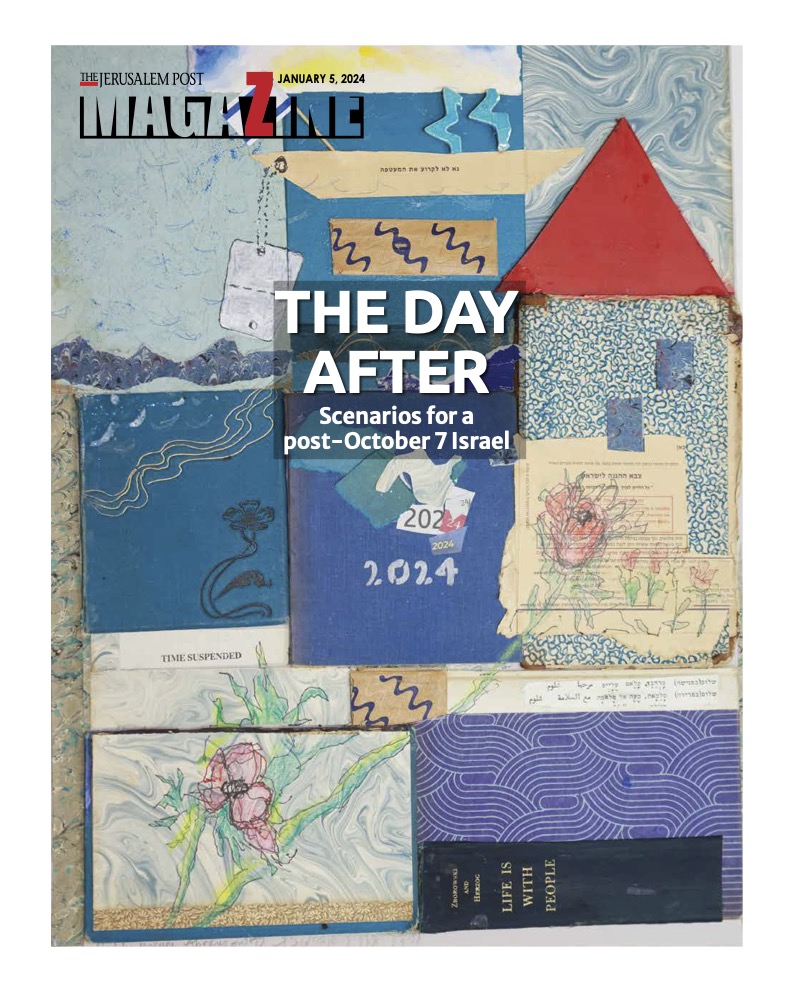
Related Article: The Day After: The ideological assault on Israel
The Jerusalem Post, January 5, 2023
Abstract: Israel must take into account new interrelated geopolitical realities that will likely emerge from the war.
Post-two-state solution: The Gaza war put a decisive end to the two-state solution. This is not due to Hamas’s attack nor to its 72% support rate among Palestinians. It is also not due to Israeli and Palestinian rejection of the template. The two-state solution died due to Western reaction to Oct. 7.
The two-state solution was based on the establishment of a demilitarized Palestinian state with various restrictions to accommodate Israel’s security needs, such as Israel controlling the Palestinian state’s airspace and border crossings.
The UN, the media, and Western politicians killed the two-state solution when they placed Hamas’s Oct. 7 attacks in the context of the occupation of Gaza. They indoctrinated the world that Gaza was under occupation, in spite of the fact that Israel fully withdrew from Gaza in 2005. If Gaza was under occupation, then certainly the future state of Palestine would be under occupation:
There would be Israeli military presence, settlement blocks, and ample restrictions. Hence, global public opinion would utterly reject the idea of an “occupied” state of Palestine, which is the cornerstone of the two-state solution: Full Article
Scroll down for videos connecting Judaism 3.0 frameworks to today’s situation
Related: The ideological assault that fuels Hamas physical assault
Related: Anti-Zionism is a threat to Global Stability
Anti-Zionism – the contemporary path to eradicate Judaism (Sept. 13, 2023)
Jerusalem Post Special Magazine: Are we in Judaism 3.0?:

Gol Kalev shows how anti-Zionism has turned into an existential threat to Judaism, in a Jerusalem Post article series (2022)
The implications of Judaism 3.0:
This generation’s existential threat to Judaism
Applying Herzl’s thinking to counter Israel-bashing

Occuptionalism: The new form of Colonialism is hijacking the Palestinian cause
Occupationalism is enabled by the Jerusalem-based “Conflict Industry,” known for its lavish parties, insularity, high turnover and its own social hierarchy

European blood libels continue, but now there is a solution
Recognizing that we are in Judaism 3.0 would address existential threats to Judaism, but it would also provide Jewish clarity that would advance humanity

Judaism 3.0: Turning threats to Judaism into enablers of its survival
Like antisemitism in Herzl’s time, today’s Israel-bashing and assimilation of American Jewry also have hidden assets in them

Passover to Shavuot and the American-European divide
How the transition affects today’s geopolitics, the flaws of democracies and the emerging rift: Americanism vs. Europeanism

Threat to Judaism through friends, influenced by Israel-bashing movement
Applying Herzl’s thinking, the threat to Judaism might come through our friends. Such Israel-bashing-light was showcased in the Basel Zionism celebrations in 2022

A broad recognition of Judaism 3.0 would release the Arabs of the Middle-east from debilitating European dogmas that have occupied their true character for the last 100 years

See in Link: Applying Judaism 3.0 to the countering Israel-Bashing
See also The Jerusaelm Report 2022 New Year Magazine: Judaism’s transformation to Zionism – Countering the Israel-bashing movement
Recognizing that Judaism has transformed would rob the Israel-bashers of their starting point: The premise that Judaism is merely a religion.

Summary of above articles:
Gol Kalev shows how Israel-bashing is today’s existential threat to Judaism, having both a populous dogmatic retail component – Occupationalism, and institutional destruction mechanisms that deploy modern-day blood-libels. In such circumstances, Hasbara (Israeli PR) is futile. Yet, a broad global recognition that Judaism has transformed to Judaism 3.0, and Zionism is now its anchor, would dramatically mitigate the threat.
Related. Jerusalem Post Magazine Cover-articles by Gol Kalev:: EUROPE & JERUSALEM
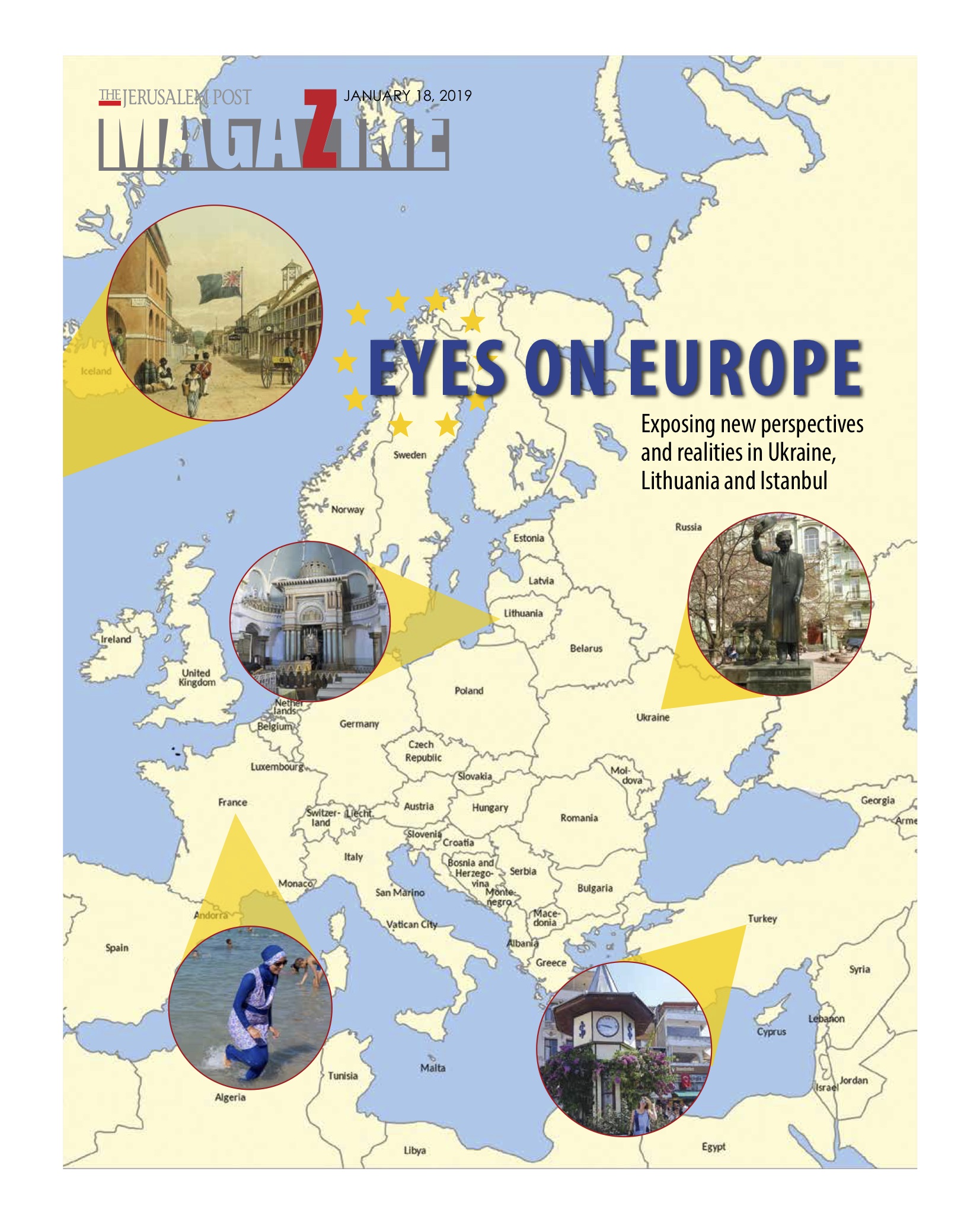


The resurfacing of European Colonialism
Hijacking the Palestinian cause
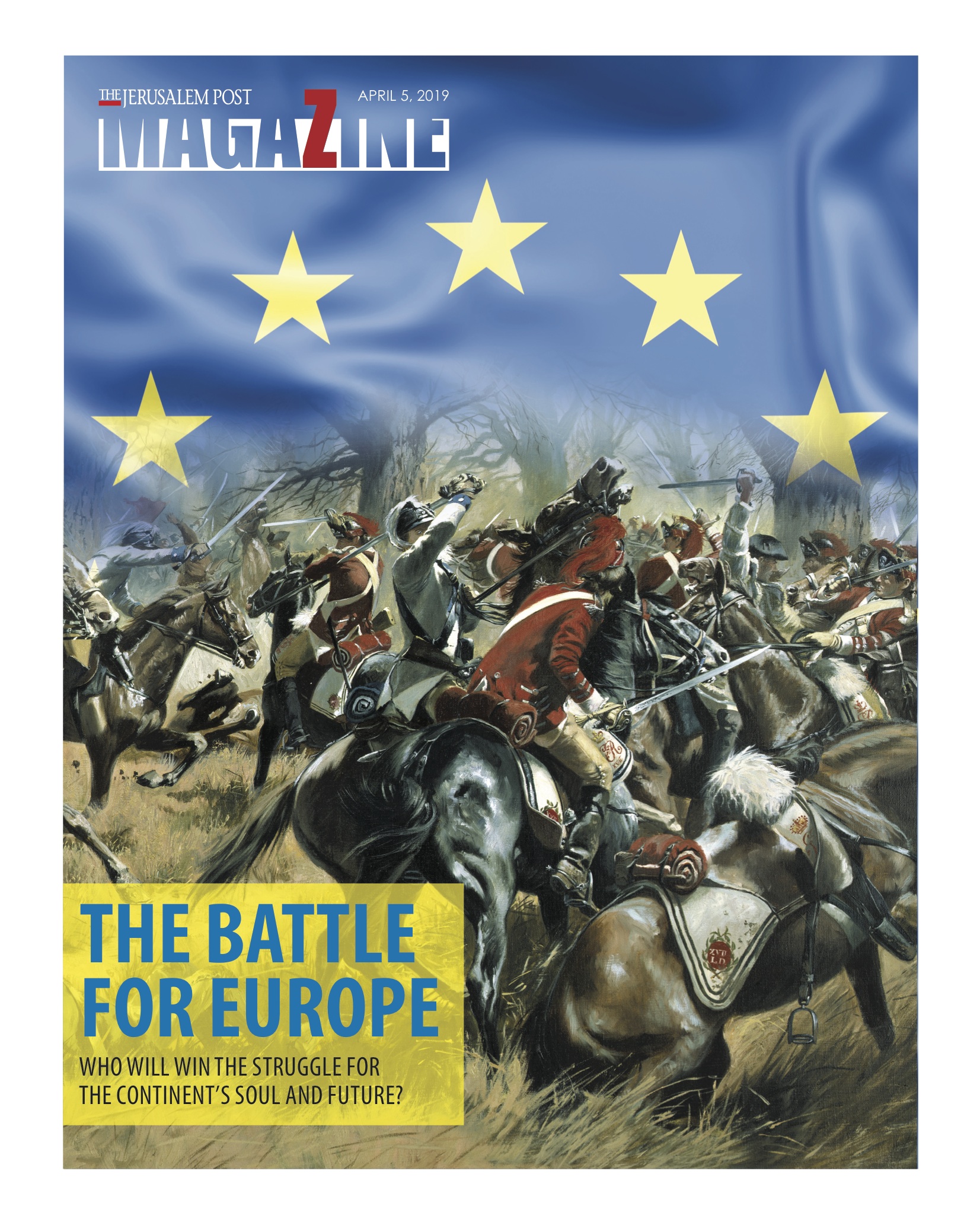
European opposition to the Jewish state
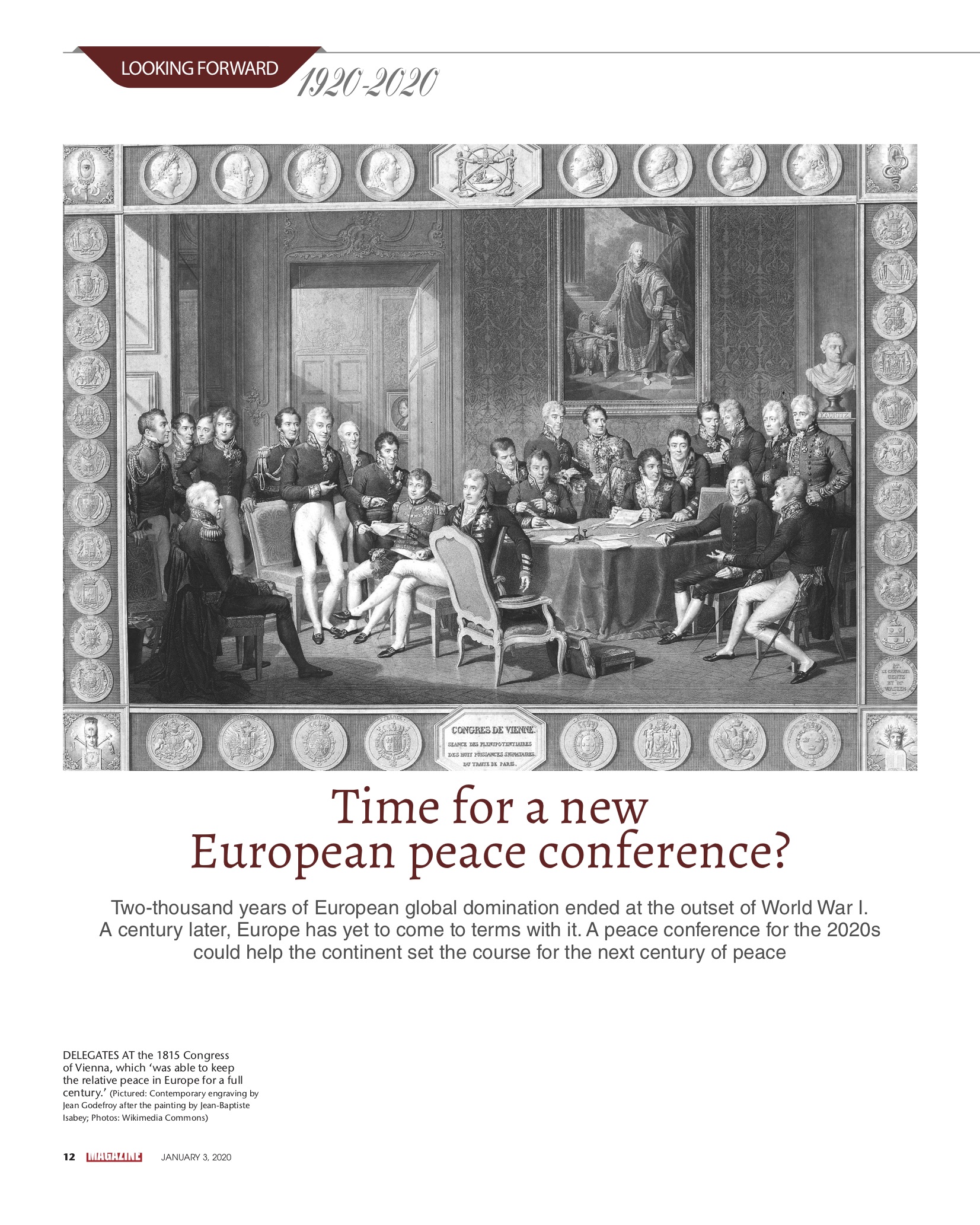
Time for a new European peace conference
Europe should benefit from Herzl’s vision
For inquiries/comments: info@europeandjerusalem.com
Judaism 3.0 launch: Revolutionary approach to coutnering Israel-bashing

Watch Gol discuss his new book in an i24 interview
Watch Gol Kalev address to the Jerusalem Leaders Summit
Related article: anti-Zionism is anti—humanity
Praise for Judaism 3.0
“A courageous thesis that must be part of any serious discussion of the future of Israel and the Jewish people.”
Michael Oren, historian, former ambassador of Israel to the United States
“Gol Kalev does not just know Theodor Herzl – he lives and breathes Theodor Herzl…This book should trigger the conversation the Jewish community needs about Israel, Zionism, Judaism and Identity. Bravo!”
Professor Gil Troy, author – The Zionist Ideas
ייA remarkable ideas book that is about much more than the state of Judaism…One of the most important books about Judaism, Zionism and global trends of our times.”
Catherine Carlton, former Mayor of Menlo Park, Silicon Valley tech entrepreneur
“This book should play an important role in the discussions about the future of world Jewry and its relations with Israel.”
Natan Sharansky, former Chairman of The Jewish Agency, former Deputy Prime Minister of Israel
“Gol Kalev’s book has the merit to transform the very essence of the State of Israel to becoming an objective expression of Jewish identity“
Dr. Georges Yitzhak Weisz, author – Theodor Herzl: A New Reading
“This book has sparked as much conversation as it has because the premise is so interesting, so counter-intuitive and demand of us that we think many thing anew. That is perhaps the greatest gift a book can give.”
Dr. Daniel Gordis, author – We Stand Divided
“Fresh new thinking about the relationship between Judaism and Israel. Kalev picks up where Herzl left off…A must read for people of all religious and political backgrounds who want to get a deeper understanding of the state of Zionism and Judaism today.”
Fleur Hassan-Nahoum, Deputy Mayor of Jerusalem
About the Author: Gol Kalev is a former Wall Street investment banker who has been researching Herzl and Zionism. Growing up in Tel Aviv and serving in the Israeli army, he then lived in New York and now resides in Jerusalem. He also spent time in various European cities and has traveled through both the American and European countryside, learning about contrasting world-views.
He has been chairman of The AIFL Think Tank since 2011 (now the Judaism 3.0 think tank), which explores the state of Zionism and Judaism, and has been writing analysis articles about Zionism, Europe, global affairs and long-term geopolitical shifts for the Jerusalem Post, Jerusalem Report, Israel Hayom, The Daily Wire, The Media Line, Newsweek and Foreign Policy.
He has been praised for his unique understanding of Judaism by people throughout the political and religious spectrum. In this book, he delivers the state of Judaism as he sees it: Zionism as the anchor of Judaism.
Visit the Judaism 3.0 website: Judaism-Zionism.com
Mazo publishing is offering organizations and companies who wish to purchase 100 copies or more, a special edition of Judaism 3.0 with a dedication page. For information:
 Europe and Jerusalem