ELITE UNIVERSITIES’ position ON THE ISRAEL-HAMAS WAR TRIGGERED A DEBATE: ARE THEY NEEDED?
Reprints from the JERUSALEM post, November 10, 2023
The world was stunned recently not only by the skyrocketing of antisemitism and pro-Hamas support at university campuses in the US, but also by the stance of elite universities that allowed this to happen. The UC Berkeley Department of Ethnic Studies, for example, offered extra credit for students who attended a pro-Hamas rally.
Such encouragement at universities to support murder, rape, beheading, and burning of Jews is masked as “pro-Palestinian” – in itself, an Islamophobic suggestion that all Palestinians support terrorism.
Within two weeks in October, there was a de-facto rebranding of Harvard, Berkeley, and Cornell. These names – once associated with education, career-building, and academia – are now mentioned in the news, social media, and casual conversations almost exclusively in the context of antisemitism, hate, and conflict.
This led various donors to immediately stop their funding and cut their ties to universities. But perhaps equally dangerous to universities is that their behavior suddenly awakened a question that has been brewing under the surface for several years now.
Are universities needed?
A number of unrelated global processes govern this conversation, such as the democratization of knowledge that occurred over the last decades. Education, knowledge, and training can now be acquired in more effective ways online, such as in virtual courses and digital libraries and through Artificial Intelligence platforms. The concept of education-acquisition at a physical location – i.e., a college campus – had become antiquated. Then came Covid, which turned the theory into a practice. A “proof-of-concept” was developed, showing how physical campuses may no longer be needed.
Universities, however, provide much more than education; they also provide “uniformity of thinking.” Indeed, that was needed in previous centuries to advance society. It was important for leaders to think through similar frameworks. But now, there is broad acceptance that such uniformity has a liability component that might outweigh the benefit. The Israeli shock over Hamas’s attack on October 7 is already attributed in part to such “uniformity of thinking” within the military-political establishment.
Ivy league and other top-notch universities pride themselves in having a high percentage of lecturers with PhDs – in some universities, close to 100%. But with the changing world environment, this by itself could be viewed as a liability, robbing students of teachers with “real-life” experience. A complete reversal in coming years is possible. Would the capping of lecturers with PhDs to, say, 50%, at elite universities be deemed as a mark of excellence in education?
There is a global trend to shift power away from old elites associated with the university system’s “uniformity of thinking” – in the US, to “flyover country” and minority populations; in Israel, to the religious/traditional majority.
In addition, there has been a growing trend of “de-conglomeration.” Once it was the bank that provided all of one’s financial needs. Today, most people get their financial services – mortgages, credit cards, asset management, checking accounts, retirement savings – from different providers.
In a similar manner, one can argue that a law school need not be associated with science-research facilities – neither organizationally nor physically.
As for social and life-preparation benefits, it has now been put to question whether university years are value-adding or value-destroying for young adults. Rituals such as “initiation” to a fraternity or sorority have been replaced by “initiation” to indoctrinated Israel-bashing ideology.
Jerusalem Deputy Mayor Fleur Hassan-Nahoum, who studied this phenomenon, explained in a recent Judaism 3.0 symposium about anti-Zionism that universities present true dangers to Jewish continuity: “We are losing our kids. They are led to believe that they can either be pro-human rights or pro Israel.”
This, while there are alternative life-preparedness models, such as the military and national service in Israel or the Mission in Mormon society.
Add to that the humongous cost of attending universities, which in itself creates social strata, life-long stress, and even birth-suppression, and the question becomes inevitable: Are universities needed?
Such a grand question was set to be deliberated over the next decades, in a slow and nuanced pace.
But then came October 7…
The October suicide of universities?
Universities’ behavior in the aftermath of Hamas’s massacre shocked Jews, Christians, and Muslims alike.
Cornell Jewish students were on lockdown at the Kosher dining hall; Harvard Jewish students were in danger after the university allowed 33 student organizations to put out a letter blaming Israel for Hamas’s atrocities. (Harvard used to limit the admission of Jews; now it admits Jews, but apparently places their lives in danger).
Through their actions, universities both awoke the dormant debate of whether they are needed and placed themselves in potential financial peril. The donors who have already pulled their funding may just be the preamble to bigger problems.
Universities depend on governments – for tax-exempt stature, for funding, for permits, for partnership. Universities cannot survive without the support of the government. Their refusal to stand against Holocaust 2.0 puts them on a collision path with the US, its citizens, and its values.
In addition, millions of outraged alumni, many still in debt, might now demand to get their tuition reimbursed. They purchased something different when they dedicated their life savings, not an association with an institution that houses hate, bigotry, and antisemitism.
This is not the first time that universities find themselves at the forefront of Jew-hatred. In the late 19th century, universities in Europe served as the breeding ground for antisemitic ideology – the expression of Jew-hatred of that time. That is what pushed a young student, Theodor Herzl, towards the idea of Zionism – a transformation of Judaism that saved the Jewish nation.
Today, universities in the US serve as the breeding ground for anti-Zionist ideology – the contemporary expression of Jew-hatred.
Will universities reverse course and save themselves? Or is it too late?
The writer is author of Judaism 3.0: Judaism’s Transformation to Zionism (Judaism-Zionism.com), and chairman of the Judaism 3.0 think tank. To read his geopolitical articles, go to: EuropeAndJerusalem.com
Scroll down for videos connecting Judaism 3.0 frameworks to today’s situation
This article is a reprint from the November 10, 2023 Jerusalem Post Magazine. Click for PDF of the magazine:
Related: Those who curse and those who bless

More strategic analysis relating to the Gaza war in Gol Kalev’s daily commentary on American Sunrise: European contributoin to the conflict
Gol Kalev argues that Judaism is going through a historic transformation and Zionism is becoming its anchor (Judaism 3.0).
Increasingly, Jews and non-Jews alike relate to Judaism through Zionism and Israel, whether in the positive and the negative. Zionism has become the most relevant aspect of Judaism. Therefore age-old opposition to Judaism is now expressed through anti-Zionism and Israel-bashing
This has far reaching implications, including in crafting strategies to counter new existential threat to Judaism
Watch the recent Judaism 3.0 discussion: Anti-Zionism as the new Anti-Semitism
Jerusalem Post Special Magazine: Are we in Judaism 3.0?:

Gol Kalev shows how anti-Zionism has turned into an existential threat to Judaism, in a Jerusalem Post article series (2022)
The implications of Judaism 3.0:
This generation’s existential threat to Judaism
Applying Herzl’s thinking to counter Israel-bashing

Occuptionalism: The new form of Colonialism is hijacking the Palestinian cause
Occupationalism is enabled by the Jerusalem-based “Conflict Industry,” known for its lavish parties, insularity, high turnover and its own social hierarchy

European blood libels continue, but now there is a solution
Recognizing that we are in Judaism 3.0 would address existential threats to Judaism, but it would also provide Jewish clarity that would advance humanity

Judaism 3.0: Turning threats to Judaism into enablers of its survival
Like antisemitism in Herzl’s time, today’s Israel-bashing and assimilation of American Jewry also have hidden assets in them

Passover to Shavuot and the American-European divide
How the transition affects today’s geopolitics, the flaws of democracies and the emerging rift: Americanism vs. Europeanism

Threat to Judaism through friends, influenced by Israel-bashing movement
Applying Herzl’s thinking, the threat to Judaism might come through our friends. Such Israel-bashing-light was showcased in the Basel Zionism celebrations in 2022

A broad recognition of Judaism 3.0 would release the Arabs of the Middle-east from debilitating European dogmas that have occupied their true character for the last 100 years

See in Link: Applying Judaism 3.0 to the countering Israel-Bashing
See also The Jerusaelm Report 2022 New Year Magazine: Judaism’s transformation to Zionism – Countering the Israel-bashing movement
Recognizing that Judaism has transformed would rob the Israel-bashers of their starting point: The premise that Judaism is merely a religion.

Summary of above articles:
Gol Kalev shows how Israel-bashing is today’s existential threat to Judaism, having both a populous dogmatic retail component – Occupationalism, and institutional destruction mechanisms that deploy modern-day blood-libels. In such circumstances, Hasbara (Israeli PR) is futile. Yet, a broad global recognition that Judaism has transformed to Judaism 3.0, and Zionism is now its anchor, would dramatically mitigate the threat.
Related. Jerusalem Post Magazine Cover-articles by Gol Kalev:: EUROPE & JERUSALEM




The resurfacing of European Colonialism
Hijacking the Palestinian cause
European opposition to the Jewish state
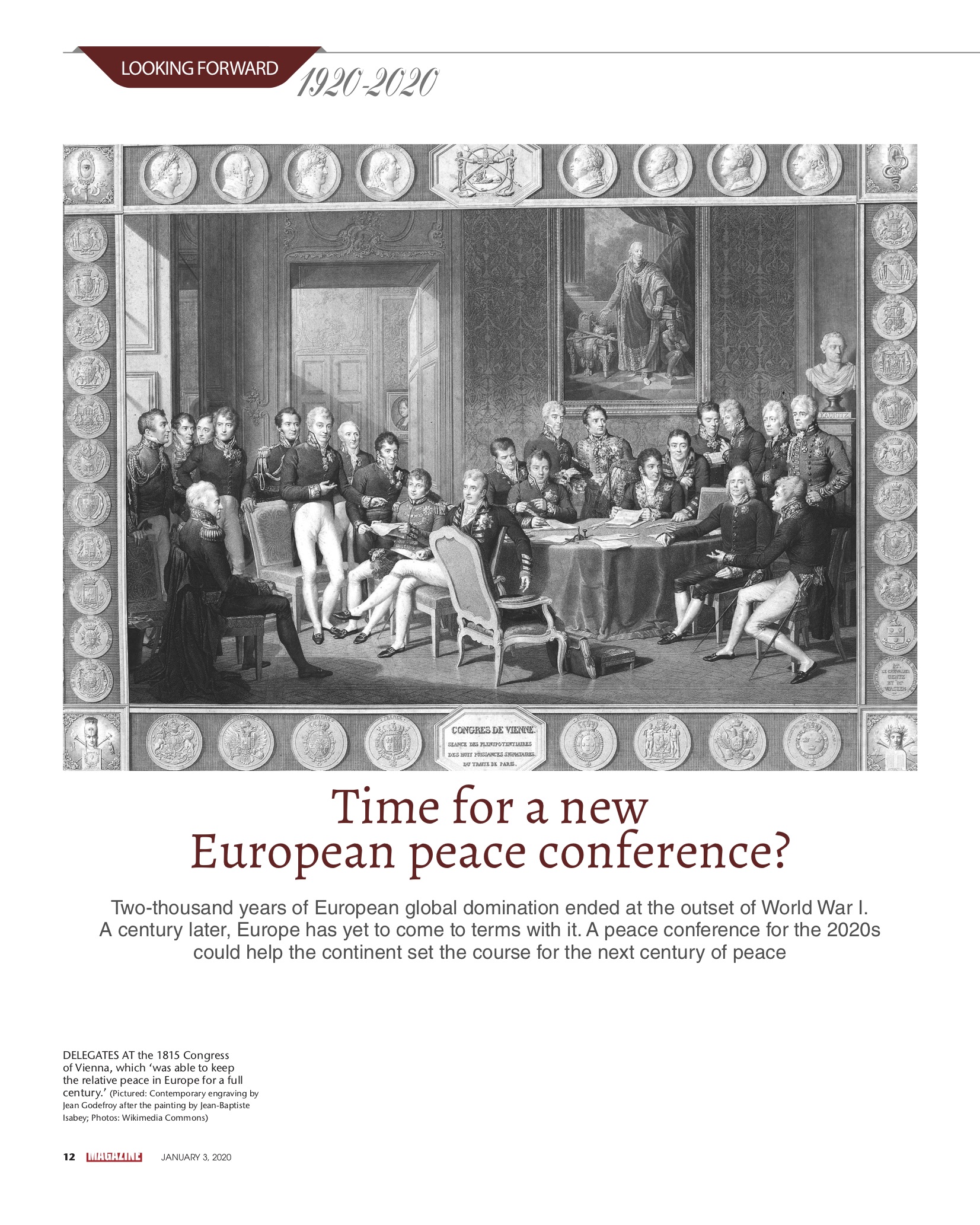
Time for a new European peace conference
Europe should benefit from Herzl’s vision
For inquiries/comments: info@europeandjerusalem.com
Judaism 3.0 launch: Revolutionary approach to coutnering Israel-bashing

Watch Gol discuss his new book in an i24 interview
Applying the frameworks of Theodor Herzl to today
Judaism 3.0 event: Applying Herzl to today’s strategic issues
Watch Gol Kalev address to the Jerusalem Leaders Summit
Related article: anti-Zionism is anti—humanity
Praise for Judaism 3.0
“A courageous thesis that must be part of any serious discussion of the future of Israel and the Jewish people.”
Michael Oren, historian, former ambassador of Israel to the United States
“Gol Kalev does not just know Theodor Herzl – he lives and breathes Theodor Herzl…This book should trigger the conversation the Jewish community needs about Israel, Zionism, Judaism and Identity. Bravo!”
Professor Gil Troy, author – The Zionist Ideas
ייA remarkable ideas book that is about much more than the state of Judaism…One of the most important books about Judaism, Zionism and global trends of our times.”
Catherine Carlton, former Mayor of Menlo Park, Silicon Valley tech entrepreneur
“This book should play an important role in the discussions about the future of world Jewry and its relations with Israel.”
Natan Sharansky, former Chairman of The Jewish Agency, former Deputy Prime Minister of Israel
“Gol Kalev’s book has the merit to transform the very essence of the State of Israel to becoming an objective expression of Jewish identity“
Dr. Georges Yitzhak Weisz, author – Theodor Herzl: A New Reading
“This book has sparked as much conversation as it has because the premise is so interesting, so counter-intuitive and demand of us that we think many thing anew. That is perhaps the greatest gift a book can give.”
Dr. Daniel Gordis, author – We Stand Divided
“Fresh new thinking about the relationship between Judaism and Israel. Kalev picks up where Herzl left off…A must read for people of all religious and political backgrounds who want to get a deeper understanding of the state of Zionism and Judaism today.”
Fleur Hassan-Nahoum, Deputy Mayor of Jerusalem
About the Author: Gol Kalev is a former Wall Street investment banker who has been researching Herzl and Zionism. Growing up in Tel Aviv and serving in the Israeli army, he then lived in New York and now resides in Jerusalem. He also spent time in various European cities and has traveled through both the American and European countryside, learning about contrasting world-views.
He has been chairman of The AIFL Think Tank since 2011 (now the Judaism 3.0 think tank), which explores the state of Zionism and Judaism, and has been writing analysis articles about Zionism, Europe, global affairs and long-term geopolitical shifts for the Jerusalem Post, Jerusalem Report, Israel Hayom, The Daily Wire, The Media Line, Newsweek and Foreign Policy.
He has been praised for his unique understanding of Judaism by people throughout the political and religious spectrum. In this book, he delivers the state of Judaism as he sees it: Zionism as the anchor of Judaism.
Visit the Judaism 3.0 website: Judaism-Zionism.com
Mazo publishing is offering organizations and companies who wish to purchase 100 copies or more, a special edition of Judaism 3.0 with a dedication page. For information:
 Europe and Jerusalem