For nearly 80 Years, the West’s message to palestinians in Gaza was clear: “You are not from Gaza!”
American Sunrise, February 11, 2025
Full interview:
More Media Appearance by Gol Kalev this week:
Gol discusses the Assault on Judaism on the Eve Harrow podcast:
Gol is interviewed by the Media Line about his book:
To Come – February 13, 2005
Gol answered wuestions on Turmps’s Gaza proposal:
Related articles by Gol Kalev
Israel and the International Criminal Court’s Threat to the U.S. (Wall Street Journal)
Trump should pronounce the two-state solution dead (Jerusalem Post)
In his book, The Assault on Judaism (October 2024), Gol portrays the Western failure to let Gazas leave Gaza, as a flagrant violation of human rights, and explores what is behind it. He discussed this aspect with Washington Times editor, Cheryl Chumley, on January 22, 2024: Dehumanization Forcing Palestinian refugees to stay in Gaza
Previous article:
Paving the path to peace
Trump should pronounce the two-state solution dead
Jerusalem Post, February 4, 2025
The two-state solution, the gold standard of Western Middle East policy for decades, was predicated on two foundational pillars. One related to the “state,” and the other to the “solution.” Both pillars collapsed over the last year.
End of the ‘state’ part (2023)
In most variations of the two-state solution, the Palestinian state was demilitarized, with various restrictions to accommodate Israel’s existential security needs, such as Israel retaining the airspace and keeping control of border crossings. This became known as a “state-minus.”
October 7 ended the template, not due to Hamas atrocities, as much as due to the Western reaction to it. While Israel fully withdrew from Gaza back in 2005, over the last year, Western public opinion was shaped to believe that “October 7 did not happen in a vacuum,” to use UN Secretary-General António Guterres’s words.
Gaza was under “occupation,” “blockade,” or “siege,” pundits explain in Western media since Israel controlled what could go into the Strip.
If Gaza was considered under occupation a day before October 7, certainly the state of Palestine would be considered under occupation on day one.
Western public opinion of 2025 no longer tolerates a “state-minus.” Moreover, as discussed in last week’s column, the Palestinian issue has shifted in recent years from being viewed in the context of problem-solving to that of “rights” and, since October 7, “inalienable rights.”
Those Palestinian rights include the right to their airspace, control of their borders, and building their own military – rights given to any other nation, the Western logic goes. Indeed, the topic of Palestine is no longer about peace-making; it is about “justice.”
Therefore, unlike two years ago, the Western mindset would passionately and aggressively reject the two-state solution: a secured Jewish state living next to an “occupied” Palestinian state.
Given that a full-fledged Palestinian state is out of the question and viewed as suicidal for Israel, the two-state solution template became a self-contradictory farce.
End of the ‘solution’ part (2024)
The second pillar was about the “solution” – a durable arrangement that will stand the test of time. Indeed, the two-state solution assumed a stable macro-environment – in Jordan, Syria, and, in particular, in the new state of Palestine.
If the Assad regime, in place for fifty years and supported by Iran and Russia, can topple in two days, the same can happen to a nascent Palestinian state.
This is in particular since, unlike Assad, who enjoyed a steady support base of the Alawites, the Palestinian Authority, which is the nucleus of the Palestinian state, has no domestic base of support and is viewed by many Palestinians as a corrupt and detached entity.
The mere thought of an ISIS, Hamas, al-Qaeda, or Hezbollah-like affiliate taking over a Palestinian state sometime after it was established, turned the idea of the two-state solution from a template for peace to a strategic threat to Jordan, Saudi Arabia, Egypt, the West, and certainly to Israel.
With no state and no solution, the “two-state solution” came to its final end. A sad event for peace-making? On the contrary.
Removing an obstacle to peace
The two-state solution dominated peace-making to such an extent that it was taboo to explore other frameworks.
For example, the UN’s Guterres stated: “The two-state solution is the only viable path for achieving peace between Palestine and Israel.” Western leaders echoed similar messages of exclusivity over the years.
The Biden Administration even went as far as to include undermining “the foreign policy objectives of the United States, including the viability of a two-state solution,” as a supportive reason to impose sanctions.
At the same time, proponents of the template acknowledged that the two-state solution is mostly a “horizon” – a slogan that gives hope. This perhaps was reflected in former president Joe Biden’s remarks upon landing in Israel in July 2022.
Right before affirming his commitment to the two-state solution, he deviated from the speech and qualified: “even though I know it’s not in the near term.”
And still, the two-state solution, rejected by Israelis on the Left and Right, by most Palestinians, as well as many experts such as Henry Kissinger, remained sacrosanct in Western policy circles – in the State Department, the EU, the UN, and various European-sponsored NGOs: “In the two-state solution we trust.”
So much so, that when then-US secretary of state Antony Blinken was asked in July 2024 if the two-state solution is dead, he responded: “Not only is it not dead – it can’t be [dead].”
And so, with such a dogmatic, zealous self-preserving mindset, the two-state solution itself became a primary hurdle to peace in the Middle East.
The Trump administration pronouncing it dead could open opportunities for frameworks that are based on organic Middle East realities. Indeed, the last time there was Middle East peace, in 1920, it was predicated on the natural mutual interests of Arabs and Jews.
Back then, Arabs in Palestine and throughout the Middle East began expressing their nascent national sentiments through the Arab Kingdom of Syria. The Kingdom was led by King Faisal, who was pro-Zionist and supported the establishment of a Jewish homeland in Palestine (today’s Israel, West Bank, and parts of Jordan).
This organic version of the “two-state solution” ended abruptly when France invaded Syria, deposed the king, and jumpstarted a century of disruptive European intervention in the Middle East.
While we cannot go back to 1920, we can go back to the mindset of the time: truth-based peace built on organic Middle East realities, as opposed to slogan-based peace built on Western-imposed frameworks.
The Abraham Accords, just like the accords signed by King Faisal and Zionist leadership a century prior, are based on such an organic principle: Arabs in the Middle East want to partner with the Jewish state and benefit from its tremendous advancements. Let us not have outdated Western frameworks stand in the way of peace.
The writer is author of a new book, The Assault on Judaism: The Existential Threat Is Coming from the West. He is chairman of the Judaism 3.0 Think Tank and author of Judaism 3.0: Judaism’s Transformation to Zionism). His geopolitical articles are featured on EuropeAndJerusalem.com.
Gol Kalev’s new book is making an impact: Details
Related: A Palestinian state would distablize the Middle-East (Washington Times)
This article first appeared in the Jerusalem Post on February 4, 2025, in Gol Kalev’s column: The Assault on Judaism.
Previous Column articles:
The assault on Judaism in Congress: Indirectly questioning Israel’s right to exist (January 29, 2025)
New realities or Status Quo? Jewish State at a crossroad (January 22, 2025)
Era of Seismic Changes (2025): Dump old Frameworks (January 17, 2025)
Strategic Threats (2025): Turkey rises in Middle-East, Israel-bashing in West (January 8, 2025)
Hanukkah – Part II (2024): Negating Judaism as an idea (December 25, 2024)
France disrupting peace: In Syria (1920), in the West (2020s) (December 12, 2024)
The ICC Warrants: A Global Assault on Judaism (November 26, 2024)
The Assault on Judaism Penetrates Congress (November 20, 2024)
The West’s Attack on Judaism is a US National Security Issue (November 13, 2024)
Europe and Jerusalem has been featuring Gol Kalev’s geopolitical analysis since 2015: Europe and Jerusalem

Related Interviews with Gol Kalev
The Media is an actor in this war (American Sunrise)
The Assault on Judaism is coming from the West `(Washington Times)

Europe must decide: ICC or DC (Washington Times)
Western incitements against the Jewish state (American sunrise)
The Assault on Judaism was launched on October 14th, at an event hosted by the Begin Center in Jerusalem. See clips, read summary: Press Release
Watch the Full Event:
Purchase The Assault on Judaism on Amazon
For media inquiries and US Book Tour information: media@theassaultonjudaism.com
Related Jerusalem Post articles:
The assault on Judaism: Will the US hold Macron accountable as France takes the lead (Jerusalem Post, October 6, 2024)
Who decides: Who will live, who will die? (Jerusalem Post, October 7, 2024)
Response to antisemitism: Show the world that Judaism has become Zionism (Jerusalem Post, April 12, 2024)
Jerusalem Report corer: Gol Kalevs new book
Read an excerpt and Summary of the Assault on Judaism: Jerusalem Report Cover – September 23, 2024
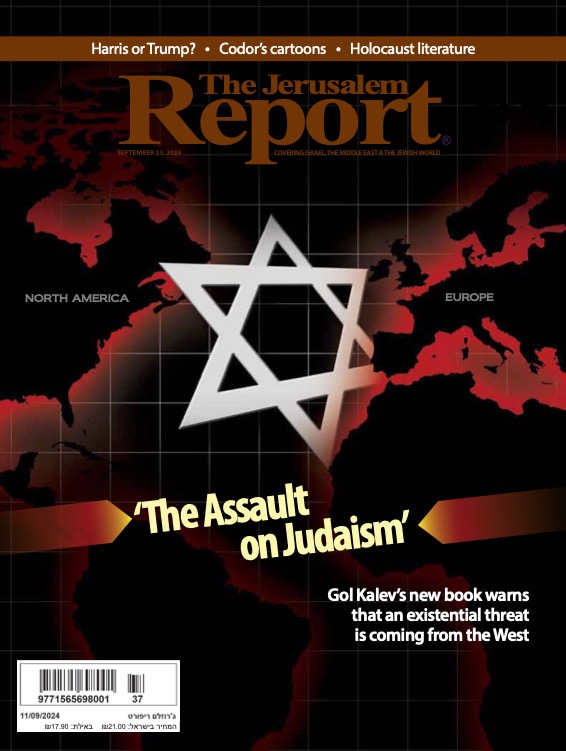
The cover the September 23, 2024 issue of the Jerusalem Report features Gol Kalev’s new book:
Reprints from The Jerusalem Report, September 23, 2024, By Gol Kalev
Judaism is facing its greatest survival challenge since the Jews were deported from Judea, as a nuanced, layered, yet fast-paced assault is coming from the West.
Every few centuries there is an attempt to eradicate Judaism, using destruction mechanisms that are relevant to the time. Sometimes, it is done through an attempt to kill Jews by Jews, such as in Europe during the 20th century and during the Crusades of the 12th century. Sometimes it is done through an attempt to destroy Judaism collectively, as an idea, such as in Spain during the 15th century and by the Greeks during the 2nd century BCE.
Today, Hamas, Iran, and its proxies are attempting to destroy Judaism Jew by Jew through a physical assault. However, they do not have the capabilities to eradicate Judaism. Those destruction mechanisms are housed in the West and are carried through an ideological assault on Judaism.
Like previous large-scale assaults, the attack is being channeled through the most relevant aspect of Judaism at the time. In our era, this aspect is Zionism, which has become the anchor of Judaism.
In my 2022 book Judaism 3.0: Judaism’s Transformation to Zionism, I showed that we are in the midst of a historic transformation of Judaism. I identified Israel-bashing as an existential threat to the survival of Judaism. I argued that recognizing that we are in Judaism 3.0 could help counter the threat, as the Israel-basher must stay in Judaism 2.0 – the illusion that Judaism is merely a religion. This allows the attacker to express “zero tolerance to antisemitism” (the threat to Jews and Judaism in the 20th century), while partaking in Israel-bashing (the threat to Jews and Judaism in the 21st century).
The Jerusalem Report dedicated the cover of its 2022 New Year issue to the book, with an article titled “Judaism’s transformation to Zionism – Countering the Israel-bashing movement,”which summarized the main thesis of the book. Since then, October 7 turned Judaism 3.0 from a thesis to a depiction of day-to-day life.
In my new book, The Assault on Judaism, which is being released in September, I describe the path to destruction of Judaism that was triggered on October 7. I show the interdependence between the physical attack and the ideological attack that followed, including how inevitable it was for friendly Western governments, which ferociously defend the Jewish state from physical attack, to partake in the ideological assault on Judaism.
I show the gradual activation of the destruction mechanisms. This includes the ICC and the ICJ setting the legal groundwork for the arrest of Jews en masse, and of Western governments, such as France, pledging in advance their collaboration – just as they did 80 years ago, the last time arrest warrants were issued against Jews en masse.
I show how an ecosystem is being developed for collective destruction of Judaism through DAS – demoralization, attrition, and sanctions. I also show how just like in the previous large-scale assault, there is an understandable, yet laughable, attempt to carve out “Good Jews” (Jews in America) from “Bad Jews” (Jews in Israel/Jews in the IDF/Jews in settlements).
Throughout my analysis, I draw not only on lessons from previous large-scale assaults on Judaism but also on the wisdom of Theodor Herzl, whose frameworks are becoming more and more relevant today. Indeed, just as Herzl identified back then, the lethal part of today’s assault does not come from the hard-core Israel-bashers on the fringe but from mainstream people in positions of power, who control the destruction mechanism. Those “Israel-bashers lite,” some of whom are my friends, are certainly not “organic antisemites” but are influenced by the pressure generated by the Israel-basher movement.
The ideological assault on Judaism has turned into a threat to global stability, but it has been all but ignored. A paradigm shift is needed – abandoning old conceptions and crafting long-term and short-term defense strategies correlated to the existential threat.

This is what I do in the last few chapters of the book, focusing on different stops along the path to destruction of Judaism, and tailoring a different strategy to counter each of those stops. I am glad that the book is already making an impact, and grateful that some of those in governments and media partaking in the assault invited me to present the arguments in the book, even before it was published.
Now The Jerusalem Report readers have the opportunity to be among the first to read an edited excerpt from the overview to the section of the book that outlines the strategies to intercept the path of destruction of Judaism.
BOOK EXCERPT:
Disrupting the path to destruction
Putting together an effective defense strategy against a large-scale assault involves three basic elements: acknowledging that indeed there is an assault; determining who is committing the assault; and identifying the arena in which the assault is being carried out. In the October 7 physical assault on Judaism, it was quite clear: We were indeed under a large-scale assault. It was carried out by Hamas, and the arena was Gaza. The same clarity exists for the ideological assault on Judaism: We are indeed under a large-scale assault on Judaism. It is coming from the West, and the arena for the attack on Judaism is Zionism.
Point of attack on Judaism: Zionism
To state the obvious, Zionism is not the reason for the attack on Judaism. It is the vehicle through which the ideological assault on Judaism is being made. That is because Zionism has become the anchor of Judaism.
Historically, large-scale attacks on Judaism have always been carried out through the most relevant aspect of Judaism of that time. When Judaism was anchored in the Temple, the Greeks tried to eradicate Judaism by desecrating the Temple, and the Romans by burning it. When Jews were organized in insular communities and bound together through the religious aspect of Judaism, the assault on Judaism was carried out through its theological and religious aspects. When Jews were given rights and lived freely in Europe, the attack was on the emancipated Jews – their success, freedom, and power.
Now that the Jewish state was reestablished and is thriving, Israel-bashing and anti-Zionism have replaced traditional antisemitism as the vehicle of opposition to Judaism. This is quite natural, as more and more of the world’s touchpoints with Judaism are now through Israel and Zionism.
Theodor Herzl, the father of Zionism, wrote: “How can we tell the power of an idea? When we see that nobody can ignore it – whether he is for it or against it.”
Zionism today is the one aspect of Judaism that cannot be ignored, including in opposition. Indeed, criticism of Israel has become the number one Jewish-related activity for many American Jews, by far more than going to synagogue, thinking about the Holocaust, or engaging in Jewish cultural activities.
In previous chapters of the book, I outlined the path to the destruction of Judaism and showed that we are already far along this path. To intercept that path of destruction, we need to have a deep and nuanced understanding of the various stops along this path, and tailor a defense strategy for each of those steps:
• The hard-core Israel-bashers who are leading the assault on Judaism through “pro-Palestinian” activities and slander the Jewish state and its citizens
• The Israel-bashers lite, who may not be organic Israel-bashers but are influenced by incitement in the media and by the pressure of the hard-core Israeli-bashers
• Governments that ultimately have the capabilities to activate the destruction mechanism of Judaism but also have the capabilities to defend Judaism
Each group along this path has its unique motivations, characteristics, and vulnerabilities.

Hard-core Israel-bashers
The hard-core Israel-bashers are the ones who drive public opinion against the Jews. They are the face of the assault on Judaism. They carry the “From the river to the sea” banners and accuse the Jewish state of genocide. They are the most vocal part of the assault on Judaism. However, they do not possess the destruction mechanism.
While they are not a homogeneous group, the crux of that part of the assault on Judaism are young progressives, driven by DEI (diversity, equity, inclusion) and woke values. They are characterized by strong conviction. To their credit, most of them act on a strong belief that they are doing the right thing, per their understanding of the world.
While they have strong convictions, most of them lack content. They are not acting based on firsthand experience or independent research but rather on secondhand sound bites they get from their social networks, their friends, and their “clergy” (be they progressive professors, liberal news organizations, popular social media influencers, or opinion leaders). They express their opposition to Judaism through being “pro-Palestinian,” which in their social circles is akin to being pro-women, pro-minorities, or pro-justice.
A Catalan separatist once told me that the primary problem of their separatist movement is that they are occupied by Spain and not by Israel. If they were occupied by Israel, the entire world would be pro-Catalan, and nobody would have ever heard of Palestine.
Indeed, most of those hard-core Israel-bashers waving a Palestinian flag could not find Palestine on a map. But that is utterly irrelevant.
Western pro-Palestinianism has become a culture, a fashion, and a social trend. This, for example, was expressed in the September 2023 University of Pennsylvania festival Palestine Writes. For an American to write about a longing for a physical Palestine that he has never been to, nor heard much about, is rather absurd. However, he can write about injustice, about how he can imagine life under occupation, about the travesty of oppression, the cancer of fascism, and the malaise of Zionism – and, by extension, of Judaism – which, after all, represents a counter-diversity, counter-inclusivity concept to him.
Indeed, hard-core Israel-bashers, expressed through the Western pro-Palestinian movement, are driven by their opposition to colonialism, racism, suppression of freedoms, and the violation of human rights. Palestinians are merely a vehicle.
The way to address this group is to demonstrate that the Western pro-Palestinian movement is a Western colonialist movement that hijacked the plight of Palestinians for its own benefit.
While the intention of many Western pro-Palestinians is good, they should be aware that when they put on their keffiyeh, wave the Palestinian flag and head to the protest, they are engaging in Islamophobia, bigotry, racism, and white colonialism.
Palestinians and pro-Palestinians are two different, competing movements. They have different long-term objectives, short-term goals, cultures, symbols, ethos, mottos, and banners. In the clash between the interests of pro-Palestinians and Palestinians, it is clear who wins. The Western pro-Palestinian movement is well funded, organized, and structured, with access to resources and power.
As will be discussed in Chapter 11, this is reflected in Western pro-Palestinians systematic suppression of basic Palestinian rights, such as freedom of employment, freedom of consumption, property rights, and even the right to control their assets.
Western pro-Palestinians even engage in an act of racism when they wear their keffiyeh. Indeed, the keffiyeh is today’s blackface – a demeaning stereotype of an Arab of a previous century – not of today. Such dehumanization continues when it comes with the Western pro-Palestinian attempt to deny Palestinian refugees in Gaza the right to choose whether to stay or flee the war zone. The Western pro-Palestinian movement is dependent on the misery of their Palestinian victims, and hence acts to perpetuate it, to the tune of millions of dollars.
The most effective way to defend against the attack from hard-core Israel-bashers is to bring the battle to them, and that is what Chapter 11 in the book describes: “Arena shifting: Bring the battle to the Israel-bashers’ turf.”
Israel-bashers lite
The Israel-bashers lite may have no organic interest in the assault on Judaism, but they are influenced by the pressures created by the hard-core Israel-bashers and act on it.
Unlike the hard-core Israel-bashers who show their opposition mostly through rhetoric, since they do not have a destruction mechanism, the Israel-bashers lite can assault Judaism in both rhetoric and actions – they are the ones who possess the destruction mechanisms of Judaism. They are normative people in government, media, and international organizations.
They are sensitive to public sentiment and to their assessment of where “the wind is blowing.” The politicians in this group need to get reelected; civil servants need to execute the will of those they serve; journalists need to provide information to the public that reflects the public sentiment. As that journalist who rationalized the distorted headline “Israel kills dozens of Palestinians” put it, “This is what Europeans want to hear.”
This group is not only normative, but they want to stay normative. They are therefore risk-averse and vulnerable to social pressures. They do not want to separate from the prevailing wisdoms and the presumed principles of their milieu. As a result, this group is easily influenced by incitement against the Jewish state. Israel-bashers lite are not “organic Israel-bashers”; they are “reactionary Israel-bashers.”
Unlike the hard-core Israel-basher, the one thing the normative Israel-bashers lite fear is being perceived as antisemites. While being anti-Zionist and an Israel-basher is socially acceptable and even encouraged in certain circles, being anti-Jewish is a career-ending taboo.
Israel-bashers lite operate in an echo chamber that assures them that their participation in the assault on Judaism is not antisemitic.
Once there is a broad recognition that Judaism has transformed and Zionism is now the anchor of Judaism, Israel-bashers lite will be deterred. In Chapter 12, I describe how Israel-bashers lite can come on their own to the realization that the world increasingly now views Israel-bashing and Jew-bashing as synonymous.
Governments
Hard-core Israel-bashers fueled the assault, and Israel-bashers lite activated the destruction mechanisms. However, Israel-bashers can only go so far down the path to eradicate Judaism. They need to engage the full power of governments.
This was the case in previous episodes of assault. The antisemitism ideology that became popular in Europe in the early 20th century was mostly in rhetoric until a government – the German government – stepped in. Haman’s strategy to eradicate the Jews in the Book of Esther would also been in theory only, had the Persian king not decided to engage the full force of the Persian government.
This is the case today. As it became clear in 2024 that European and other governments opted to participate in the contemporary assault on Judaism, it is now left up to the United States to intercept the path to the destruction of Judaism.
The good news is that those other governments that partake in the ideological assault are dependent on the United States for their economic, political, and national security. The US has enormous leverage.
Assault on Judaism as proxy for assault on America
Let’s be clear: The assault on Judaism is also a proxy for assault on Americanism. This is both conceptually, in an attempt to negate the principles of the American Revolution and its Judeo-Christian basis.
The infrastructure that is being set by the ICC and the ICJ to arrest Israeli soldiers and political leaders can also serve as a “plug and play” template to be used against American soldiers and political leaders.
Just as Iran views the Jewish state as “Little Satan” and attacks it in part as a proxy to attacking America – “Big Satan,” the same is with the ideological assault on Judaism. If Israel, which international military experts state has the most moral army in the world, is “Little war criminal,” America in the attackers’ view is “Big war criminal” and can be next.
Indeed, on May 28, 2024, South Africa’s Foreign Minister Naledi Pandor revealed that her country was planning to do exactly that: The US is next, she promised. Similarly, the assault on Judaism destabilizes the world and triggered a series of unrelated conversation under the “pro-Palestinian” banner – from the nascent discussion of Spanish occupation of the Iberian Peninsula to disruption of the American higher education system.
For this and other reasons, the assault on Judaism should not be treated as a matter of antisemitism but as a US national security issue. As discussed in Chapter 13, the assault on Judaism is a way to “launder” an attempt to destabilize America.
If one can intercept the assault on Judaism, one prevents the subsequent assault on America.
The US has the ability to intercept the destruction mechanism of Judaism; for example, by sanctioning the ICC and those who collaborate with it.
This is not the first time the US faced such a decision. During the previous large-scale assault on Judaism in the 1940s, the US had the ability to intercept the destruction mechanism used at the time. President Franklin D. Roosevelt evaluated the proposal to disrupt those mechanisms in the context of the range of threats the United States was facing at the time.
For the United States, neutralizing the death camps where the Nazis carried out their plan to eradicate Judaism by killing Jew by Jew would have taken resources from other crucial operations. FDR made the prioritization call and allowed the path of destruction to continue.
In our era’s assault on Judaism, it is the reverse: Disrupting the destruction mechanisms of Judaism is defending America. As discussed, the assault on Judaism embodies both a short-term and a long-term threat to America.
Unlike in the 1940s, the United States today has the capability, capacity, and pressing national interest to disrupt the assault on Judaism on its multiple levels, using various tools at its disposal and in so doing, defining America. Chapter 13 discusses those tools and offers some simple and immediate measures the US government can take to disrupt the assault
Gol Kalev is author of Assault on Judaism: The Existential Threat Is Coming from the West (TheAssaultonJudaism.com). He is chair of the Judaism 3.0 Think Tank and author of Judaism 3.0: Judaism’s Transformation to Zionism (Judaism-Zionism. com).
Purchase The Assault on Judaism on Amazon
 Europe and Jerusalem